
Free speech is pointless if nobody is listening
No rights without duties

In the wake of Charlie Kirk’s murder the commentariat is fizzing with hot takes about free speech. People need to be able to debate. To hear difficult ideas. Most ironically, to be civil. What I hear vanishingly little of is calls to listen and, reciprocally, to speak in a way that makes it possible for people to listen. Relatedly, to create spaces that are conducive to listening. Debate clubs and debate culture - of which Kirk was explicitly an unashamedly an advocate - actively undermine this sort of thing and are part of the problem. This is an area where my thinking has grown more sophisticated over time (I think it’s important to remember that most cancel culture enthusiasts are young people who need certainty and very old people who mistake their loss of brain plasticity for certainty) and I want to share some of that with you.
Most of us have had at least one conversation in our life that was hard but rewarding. We listened to things that were difficult to hear, said things that were hard for our interlocutor to hear, learned things about them and ourselves and the world we live in, reappraised our views, perhaps healed from something, grew as a person and perhaps even as a community, or just learnt something. Maybe this was a conversation with a political opponent, or someone who hurt you, or a colleague who saw the work differently to you. In any case, it was a tough but ultimately positive experience.
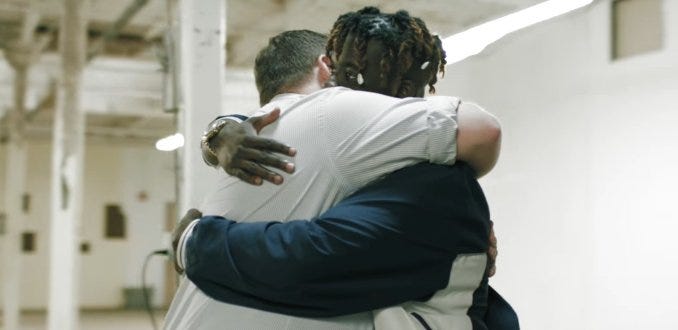
What characterises such conversations? An unexhaustive list:
First and foremost, is the sincerity of the participants. They turned up in good faith. They had some trust for the people they were talking to. While there might have been too much on the line to entirely avoid sophistry and the like, they were at least broadly honest and forthright. In the best cases, people are talked down from their sophistry, made to feel safe to be vulnerable and earnest. There was a willingness to compromise (certainly to find win-win outcomes and synergies). An open-mindedness and, crucially, an open heart. Hard conversations are often most fruitful when all the parties arrive with an understanding that they lack some knowledge, whether intellectual or emotional (or physical). They are missing something that would allow them to inhabit their interlocutor’s point of view and comprehend their position. This is why design work is so satisfying - because everyone arrives accepting their own ignorance and they work collaboratively to overcome it.
Second is respect: the parties to the dialogue regard each other as full human beings with well thought-out and felt-out positions that are worth listening to, steel-manning, and comprehending, insofar as such a thing is possible. They treat each other with courtesy and professionalism, not necessarily the way they would a close friend but certainly the way they would someone they want to maintain a connection to.
Third, safety. Hard conversations are hard! Doing hard things is much easier when you can be vulnerable. When you can admit what you’re scared of, or where there are holes in your argument, or where you’ve only got a strong intuition that you can’t quite express but you’re hoping your interlocutor can meet you there in your feelings. Safety must be created. That’s why therapists offices are usually very mild spaces, why silent meditation retreats are mellow and steady, and why people do break ups in parks. When you want someone to feel safe you offer them a drink, you invite them into a pleasant environment, you ask open ended questions that let them speak the way they want and you engage in active listening so that they feel heard. You try to see everything in them in the best light and interpret what they say generously.
Sincerity, respect and safety foster dialogue and discussion and lead to rapport, insight, meaning, and understanding. These things are all very conducive to liberalism and democracy, so we should be fostering them in civics education (and when we’re teaching people how to have healthy relationships). A constructive dialogue allows us to inhabit our interlocutor’s perspective using our amazing human capacity for empathy and come to know things the way they do, and vice versa.
Free speech advocacy within ‘debate me’ culture is a perverse inversion of all the above conditions for meaningful dialogue and unsurprisingly leads to more partisanship, hard feelings, and violence, not a political community. The style of debate culture is inherently combative and aggressive, which doesn’t foster safety. Interlocutors are perceived as morons, not someone worthy of respect. And you are encouraged to use whatever means necessary to ‘win’ the argument, which discourages sincerity and especially vulnerability and openness.
The emphasis on speech in debate culture is misplaced. Commentators say “people need to hear things they disagree with”. But if spaces are not made to foster dialogue then this sentiment inevitably degenerates to a less powerful side being made to hear things they disagree with without scope for meaningful reply. A normie white boy isn’t going to have his perspective listened to in a class on radical feminist politics, and his questions might even be mocked. This is partially because he doesn’t understand his own views (they’re socialised rather than theorised) and he’s bad at articulating them, but it’s also because the class won’t help him to compose them. That’s fine to a large extent - the class isn’t for his views and he can be expected to expose himself to new ways of thinking. But the class also shouldn’t be actively hostile to his ignorance nor vilify him, which does happen (inversely in e.g. economics classes). Equally, nobody from ‘the left’ is going to be listened to in a Turning Point USA forum, and nobody who grew up properly poor is going to be listened to at Trinity College Cambridge’s high table. They’ll be illegible to the people around them. And, crucially, those people won’t be interested in helping them to become legible. In debate, an ‘opponent’ who doesn’t make sense is a boon. In dialogue, it’s the first issue to be addressed.
A further perversity in debate culture is that ‘civility’ means playing by the incumbent’s rules, rather than incumbents creating an environment where the guest can be heard. Debate culture creates a high risk, high tension, high stakes environment. I know because I’ve spoken at the Cambridge Union. That shit is stressful, and we were in an inconsequential philosophical debate, not discussing whether colonialism was good actually or some other such politically spicy topic. Such environments only attract warriors, or at least people who are willing to fight, so the discourse is tainted from the outset. Such people are then understandably combative, aggressive, rude even, like Christopher Hitchens. They have been asked to enter the lion’s den ffs! Of course their sword is drawn. But then this combative stance is regarded as ‘uncivil’, ‘impolite’. The audience here creates a pretext to deafen themselves to what the guest has to say, but they’ve created the conditions for this incivility. It’s all falsehood - they never wanted to listen. They never created the conditions for civil exchange. Being civil means agreeing with them in the first place.
A right to free speech without a duty to sincerely listen is basically a right to call people you disagree with a piece of shit and act like a hero when they get upset.
I can’t help but see machismo in this culture. It’s all about debate, combat, and winning. Very boys. Compare it to a women’s circle from 2nd wave feminism, or a men’s circle from today. In these more mature spaces the focus is on sharing, inquiry, and consciousness raising. In a debate the ‘loser’ is meant to be trampled and forgotten. In a circle they are meant to be understood, enlightened, and integrated. How does that happen? Through dialogue. Through speaking, certainly, but also being heard, and listening to others, some of whom may have hard things to say to you. Taking the heat and violence out of contemporary politics is NOT about respecting free speech. It is about dialogue, which is mostly about better listening, not more talking.
I really like your shift in focus to the environment in which any conversation is taking place, and how this either facilitates or dampens the quality of the encounter: venue, atmosphere, norms and culture of that space, etc. We have a tendency to privilege the propositional content (and often, rhetorical force) of whatever is under discussion as the "important" part, while overlooking the process and context of those facilitating conditions; the assertive over the receptive. Which also means overlooking ethics. The irony is that disagreements often revolve explicitly around matters of ethical concern and clashing values, even as the ethics surrounding how we approach and engage in this disagreement is mostly ignored. Perhaps this is because wrestling with ethically loaded topics gives the impression that we are already "doing ethics?"
One thing I would add is that even appeals to "dialogue" easily becomes a convenient rhetorical device, which functions to support the same old debate paradigm (only with some hand-waving about civility). I'm not remotely well-versed in dialogical theory/ethics, or related work in dialogic pedagogy, but one thing this literature makes clear is that a genuine dialogical exchange is a major human achievement, not something we can expect to happen of its own accord. It's not "talking across divides" but meeting in between; embracing and lingering within the space of difference, and holding those multiple voices. And as you say, listening. So escaping the familiar argument mode takes more than good intentions.
By the way, I recently stumbled across this guy who has apparently founded a Center for the Arts of Speech - new book looks interesting:
https://www.politybooks.com/bookdetail?book_slug=watch-your-words-a-manifesto-for-the-arts-of-speech--9781509567294
https://www.politybooks.com/blog-detail/watch-your-words