
Why can't people do the work?
AI won't solve climate change and other get rich quick schemes

I host dinners for junior academics and similar types once a month. A couple of weeks ago a friend who works in public opinion research asked those assembled, one of whom was an expert on climate change and another an expert on AI, whether AI will solve climate change. All assembled were fans of AI in one form or another. The responses came very quickly and firmly:
No.
Why not? Because the barriers facing climate action aren’t about knowledge, they’re about politics and coordination. AI is fundamentally the wrong tool for solving politics and it isn’t good enough to solve the coordination problem. Even if it was, it would require all the agents needing coordination to seed their agency to the AI, which isn’t going to happen. Imagine the following scenario. All the bureaucrats in the UK energy regulator arrive at work on a Monday to an email that begins:
“Greetings! I am ClimateBot and I have been empowered by Cabinet to solve the climate crisis. Here’s what I need you to do…”
How many of them would comply? In a very hierarchical bureaucracy like the UK, quite a few, but far from 100%. How many people in the private sector would comply? A much lower number. How many people opposed to climate action would comply? 0. How does AI solve the things that hold climate action back? It doesn’t.
So why are people spruiking it in places like UK cabinet meetings? My guest’s question came from sitting in high level meetings where in the last 6 months all anyone seemed to be talking about was whether AI could solve chronic complex problem x, y, z - all characterised by complexity, coordination, politics. That seems insane to me. Which raises a question - why can’t people in power do the work?
Climate change is instructive. Millions of people have been engaged in the grinding work of pivoting the global political-economy in a sustainable direction for decades. And it is working! China has seemingly hit its targets well ahead of schedule and its emissions are falling!
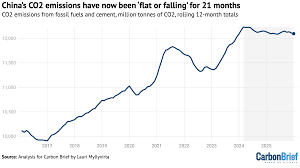
And western democracies can succeed too. To take just one example: GDP growth and energy consumption have decoupled in Sweden.
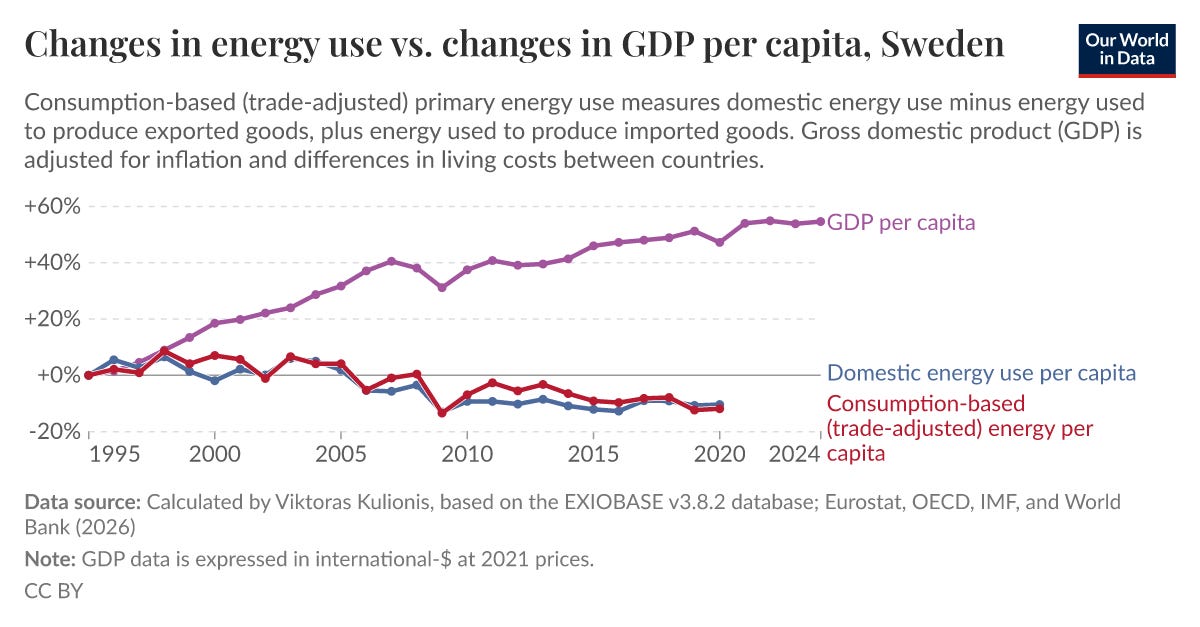
So all this work is happening, and it’s working. This is something we should be celebrating, loudly. We should be telling people that there’s hope because we’re working together. If more people join, things will get better even faster. In the face of the biggest collective problem our species has ever faced, people are coming together and acting collectively. How heart-warming.
Instead, people at the top are piqued by the idea that Claude Code might be able to take care of it even as data centre build out massively increases energy demand. Grim.
It’s grim not just because of its shear stupidity, but because it implies that leaders are abrogating their only responsibility - to lead. They are not doing the work of coming up with plans, of understanding how to message them, of convincing people of their credibility even when there are pains in the short term. They are not fostering collective action. They are instead hoping that a sprinkling of AI fairy dust will make all their problems go away. They are Jack buying magic beans, but if the beanstalk miraculously grew you know they still couldn’t be bothered to actually climb it.
There is more insight to be gleamed here about the psychology of our “leadership”. They cannot fathom a broad collective effort to address big problems. They need a single solution that can be applied from the centre. Solutions to complex system problems like climate change or fixing the National Health Service almost always require decentralisation, devolution, and localism - the system must be able to respond in real time to failures across the system. But this would require them to relinquish power, so of course our leaders cannot fathom it. They are paralysed by the risk of a bad media story even as Trump demonstrates that this does not matter one iota as long as your vibes are right.
There is also insight into the psychology of the AI boosters to be found. In the fever dreams of AI vapor ware enjoyers, Claude Code will imminently be more capable than Elon Musk of running a fortune 500 company, or NATO, or whatever. There are 100% earnest discussions going on in AI forums about a future where the fortunes of two CEOs and their companies will be decided by who is more willing to quickly throw caution to the wind and let an AI make all their decisions. The implicit model here is again one of a centralised authority figure with all the money and power making decisions. Elon Musk. It is the fantasy of Ender’s Game. We just need someone smart enough - and AI can be that someone. Never mind that in a well-functioning company the CEO is less steering and more facilitating an enormous number of managers and individual staff to make the thousands of decisions per minute required for a complex organisation to function. This is not what Elon does, which is why his companies are dependent on politics, fraud, and labour exploitation, or just outright haemorrhaging money (i.e. twitter). Piloting from the cockpit is the wrong metaphor for solving difficult problems. And giving up all agency to one super pilot is precisely the wrong strategy.
There is something similar going on among contemporary economists. The original insight of economics is the power of price signals in free markets. They give rise to an emergent order that no central planner can mimic in terms of its efficiency in allocating scarce resources. This is literally the first thing you learn in economics. Yet somehow, by the time today’s economists finish grad school, they’ve been so convinced of the power of randomised-control trials and cost-benefit analysis that they think all we need is MOAR DATA!!! If we had that, then we really could figure it all out and just centrally plan where to allocate our money. So the people who should be most enthusiastic about decentralisation, devolution, and localism are instead most stubborn about keeping financial control in the treasury because nobody else appreciates the potential of cost-benefit analysis.
Sadly, this sort of thinking - not doing the work and looking around instead for 1 big brain to fix it - is not confined to our upper echelons. Superbowl broadcasts, London Tube Stations, and small town high streets all play host to an ever expanding number of advertisements and venues for gambling, crypto currency, and questionable health fixes. Here’s one I saw recently in London:

If this was real it would be easy to find evidence for it. I spent 30 minutes on Google Scholar looking for a relevant meta-analysis or systematic review. Nothing. Testosterone has teeny effects on weight-training related fatigue in hypergonadal old men. Hypergonadal as in they don’t produce their own testosterone. Men, if you’re tired, and lord knows I am, try sleeping more, drinking less alcohol, eating better, and removing stimulation like tiktok to give your brain time to rest. These things all take work. A testosterone pill, or a slug of energy drink, or a shot of cocaine, doesn’t. So which we are people turning to? Of course there’s also a dark element here of playing on men’s fears about being small and inadequate - maybe I just need more man juice and then I’ll be a winner!
The same is true of crypto and gambling. One of the early insights of microfinance was to loan to women because they have lower risk appetite and are more likely to just work hard, be frugal, slowly get ahead, and eventually pay back their loans. My mother was the same. While my father was out gambling on horses or playing the pokies (mostly driven by his shame of being poor), my mother was picking up paychecks, shopping at the Chinese grocer because it was cheaper than the supermarket, never buying anything for herself, and saving her dollars. Eventually she left him, bought her own apartment, and now she’s wealthy. Mum did the work. It was slow, tedious, often frustrating, relentlessly demoralising, but eventually you crest the curve and things start to get easier, you build momentum, and at the end you’re a winner. Gamblers always lose by design, but in a culture where nobody wants to do the work it’s gambling that buys the advertising space.
The electoral politics of this attitude is the quick fixes and big men of populism. Oh I’m sick of all this organising, and deliberating, and get out of the vote, and compromise, and coalition building; let’s just give all the power to a big man and he’ll sort it out with a few quick fixes, like yeeting all the migrants. What ultimately ends up happening is that the big man just takes everything for himself because that’s what makes him the big man - all the money and power is concentrated in one person. There’s no interest in the collective.
Pretty much everything worth doing in your own life takes, in the words of Nietzsche, long obedience in a steady direction. Everything worth doing at the societal level takes large numbers of people working hard to all get pointed in the same direction, and then yet more work to stay obedient to that direction. You don’t ever really get to the end of social projects, you just work at them so that the next generation inherits something better, and then they keep up the work. Martin Luther King Jr: “the arc of the moral universe is long, but it bends towards justice”. You don’t even really get much of a sense of your own causal force in all this except someone occasionally saying thank you or telling you that your work helped them in some way. This is (the experience of) network problem solving in action. You have to do the work without much sense that it’s going anywhere. Just keep it at guys (nonbinary)!