
Why gambling should be banned
TW: Personal stories of trauma

My lovely wife, sweet like the first blossoms of spring, recently got a mini projector from her father in Japan. Full of gentle excitement but also almost keeling over from fatigue, we set it up last night to watch Squid Game. After a few expletives when it wanted me to connect to the internet and allow Google to spy on my home, we realised we could just use it via HDMI. Cosy on the couch, we settled in for some viewing of South Korean craftsmanship with a glass of sake.
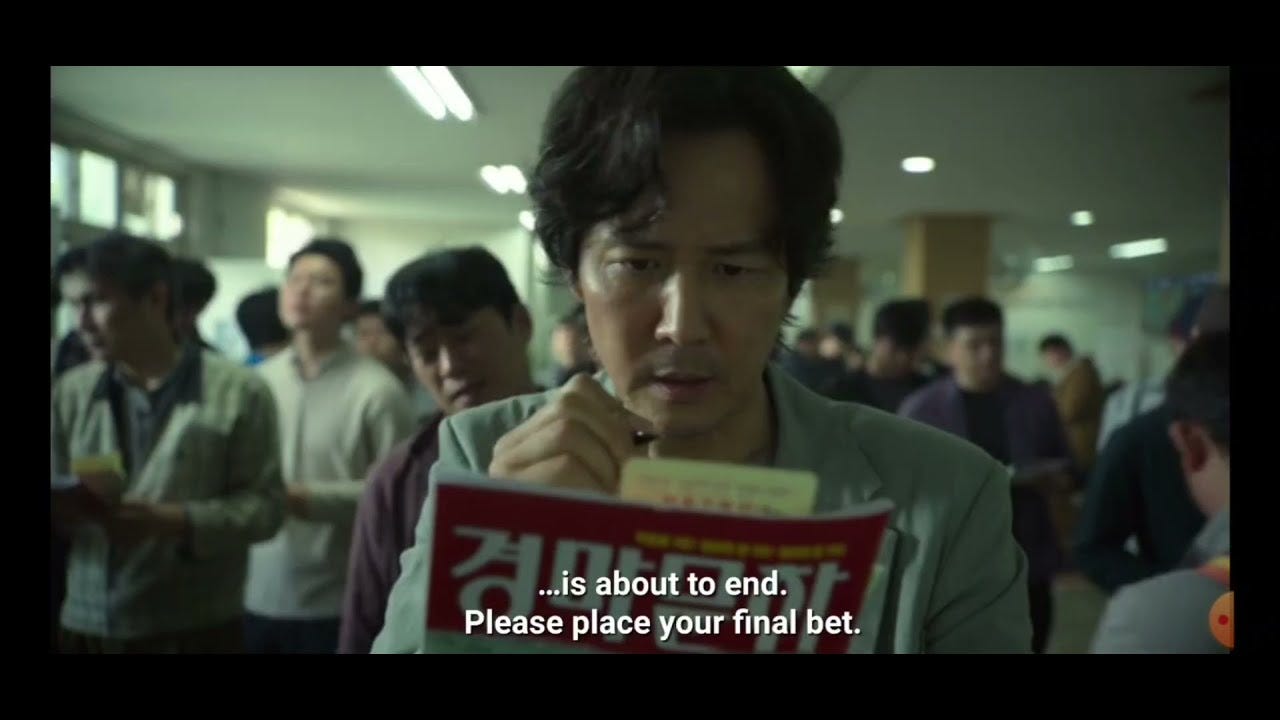
For those who don’t know, the primary trope of Squid Game, at least episode 1, is gambling. The protagonist is a gambler. Doubly brutal because it is revealed that he once had a good job, then had two small businesses, two dreams, go bust. He’s a loser. My dad was a loser too, in similar ways. So much of gambling comes from shame, and the seductive idea that you can become a “winner” just by playing a game of chance.
I didn’t realise how much trauma I was carrying about this. We had to turn the show off halfway through the first episode because I felt nauseous (which is a testament to the quality of the acting). We got through it eventually, and the next two as well wherein the squid game starts (which is basically about rich people laughing at losers dying for money). By then I realised I had been sitting on a bomb.
My dad had a major gambling problem. Pokies mostly, but also the horses. Past tense thankfully, he’s not only stopped but he nowadays invests quite sensibly, patiently, and actively in the Australian stock market. At precisely the moment in our lives when our family should have transitioned out of refugee purgatory and into the Australian migrant story we instead skirted destitution. Mum had gotten to mid-career as an academic, which gave us solid household income. Thank fortune she was our primary breadwinner. Dad was working part time as a bar manager and part time unpaid on his art projects. He got a small but meaningful inheritance from his mother with which we might have bought an apartment. He hated her so much that they hadn’t spoken in 18 years. Perhaps the money was cursed. I don’t remember the exact causal chain, but that’s when the gambling started. It ended in divorce, an empty bank account, and dad nearly drinking himself to death.
One of the scariest experiences of my life was seeing him a bit drunk and totally manic, wild eyed, home from the pokies asking for more money so he could go back because he was certain he was close to a big win. I was 14. No friend would make a bet with someone in that condition. Nobody with a duty of care would allow him to keep spinning the slots. The gambling industry rolls out the red carpet.
I nowadays occasionally find myself in communities of behavioural scientists. One of them has detailed for me at length the extreme knowledge these firms have of how to entrap someone psychologically in a self-destructive gambling habit. If you think cancelling an Amazon subscription is hard wait until you try to give up gambling. Some of the industry’s many, many strategies are detailed in this tragic Letter to the Editor of The Economist by Name Withheld, December 21 Issue (paywalled):
I was shocked, saddened, and outraged by your leader stating the boom in sports better is something to be celebrating (“America’s gambling frenzy”, December 7th). I lost my 28 year old son to suicide in May. I did not know until after his death that he had lost thousands of dollars of his hard-earned money. He had kept it secret that a sports-gambling problem had overtaken his life and mind. Based on the evidence that I have gathered since my son’s sudden death, I would argue that the “gambling frenzy” is mostly about exploiting and endangering people’s lives in the name of this predatory industry’s greed and disregard for human life, rather than being “about people being free to enjoy themselves”.
You skirted over the role of technology. The smartphone has indeed fuelled the boom. Armed with data of an individual’s betting tendencies, the industry cultivates and fuels addiction and targets those whom it has identified as problem gamblers. Horrified as I examined my son’s phone after his death, I saw first-hand how sports-gambling operators offered him free box seat tickets to live sports events, addressed directly in texts to him from a “VIP host” and “free” ($200-plus) gambling money to ensure he remained actively engaged with the multiple gambling apps on his phone.
You described online sports gambling as “often a communal activity”, and therefore less of a worry than “sitting at a [slot[ machine, alone”. The $10 000 bet my son frenetically placed on a losing NHL Stanley Cup game team during the last 48 hours of his life was followed by a series of still more frenetic bets placed in isolation on his phone to try to win back his massive loss. It is clear he died alone.
You said that “Other vices that American enjoys and taxes, like alcohol, are responsible for far more catastrophic harm”. Yet, according to recent studies in America and Britain, people who are addicted to gambling are more likely to attempt suicide than those addicted to substances.
As described by Les Bernal, national director of the Stop Predatory Gambling Organisation, the entire business model is based on human suffering - and this is normalised.
The “free bets” make me want to puke. A few months ago I was on a train to Durham for a conference. Across from me were four undergrad lads discussing their fantasy football teams. Harmless fun. Then after 30 minutes of riling each other up they whipped out their phones and starting placing their bets for the day. At one point I overhead one quip “well, it’s a free bet”. This is like the devil encouraging you to sign on the dotted line with “what have you got to lose?”.
This industry is stool water and arse-gravy and I am deeply upset and outraged that its reputation is laundered by media like The Economist. The absolute scummiest person I knew from university, who once burst into the room of a girl having sex so that he could photograph it for laughs, went first to work for one of the policy-agnostic power-brokers of the Australian Labor Party, then quickly to the gambling industry. I ran into him at a bar around that time and within 5 minutes he was offering to introduce me to his contacts. Gambling is a psychopathic and predatory industry staffed by psychopaths and predators whose only interest is profiting off the misery of other people. Working in gambling should be deeply embarrassing and shameful, like being a fraudster. It was historically a criminal enterprise and its omnipresence on high streets and advertising today speaks to the extent to which we are ruled by criminals.
One of the most tragic aspects of contemporary gambling for me is seeing the 6 or so regular customers of the 3(!) shops at my local intersection. For them the shops are clearly playing the roll of a community hub. All their friends are there. But instead of getting support, nourishment, and solidarity, they are fleeced for their meagre monies. Every few months their clothes get shabbier, their countenances more ashen, their figures more threadbare. Now one of them is regularly begging outside the local supermarket. The shops all say “gamble responsibly”, but none of them is taking responsibility for these men. And the gambling shops have replaced the community infrastructure that would have taken responsibility for them in the past. I recall Varoufakis writing in Adults in the Room about how the gambling industry moved aggressively into Greece in the wake of its debt crisis, feeding like vultures on the hopeless with idle time. When tax revenue to fund community infrastructure dries up, the gambling industry stands ready to take over the venues and suck the blood out of a neighbourhood.
There should be no organised gambling, only betting between friends. I can appreciate that sometimes people want to add an extra layer of tension to a football match between rivals, or make bets at a weekly poker game feel consequential. You can do all of this with peer to peer structures. You have no need for an industry. Friends might tease you about losing a few bets, but most of them won’t let you fork over $10 000 on a Stanley Cup game. If you had a problem, they would intervene, not fleece you. If they weren’t actually a friend and kept up a predatory relationship with you, eventually you would just stop being their friend and then you would also lose your gambling venue and regain your life. Tetlock’s Superforecasters project was polymarket with people playing for pride, not money. Now polymarket is a money laundering operation for political insiders. There’s no honest competition and thus nothing to be proud of.
I appreciate that if you illegalised gambling you would just drive it underground. Yes, that is where it belongs. Fewer people would find it underground, and fewer lives would be ruined. If your spouse was getting screwed by an illegal gambling operation you could report it to the police. If someone was caught running such an operation they would go to jail with the other criminals.
The industry talks of the taxes it pays. There are four reasons why this is bogus. First, many such companies are headquartered in tax havens and so do not pay tax. They are purely parasitic. The second reason is analogous to John Wesley’s argument against slavery:
Aye, but our colonies would be ruined if slavery was abolished. Be it so … the purses of highwaymen would be empty in case robberies were totally abolished.
You do not thank someone for paying taxes with the money they stole from you. The third reason is that gambling undermines the things we spend taxes on: policing, health, welfare, broken families, community cohesion, etc. The final reason is that this industry is in no way productive. By allowing it to exist you make the collective economic pie smaller and then take tax from that. If you instead left the money to circulate in the economy rather than being ploughed into slot machines and greyhound races it would multiply and you would have a larger tax base. The only circumstances under which this argument is remotely viable is the Singaporean model (also Indian reservations) where only foreigners are allowed to gamble. If someone goes to all the effort of travelling interstate on a planned, premeditated gambling holiday, then I guess I won’t stop them. But I will plead for them to get some better hobbies and I will mandate the casinos to have free counselling services on hand.
Gambling causes carnage within the households that are captured by it and provides no meaningful benefit that cannot be achieved with an informal rather than industrial approach. It should be banned and anyone promoting it stigmatised.